 Molly
The Simon game: how it works and how to get further
Simon is the electronic memory game from 1978. Four coloured buttons light up one after another, each with its own tone, and you press them back in the same order. Every round plays the whole sequence again with one more step on the end, until you press a wrong button or wait too long.
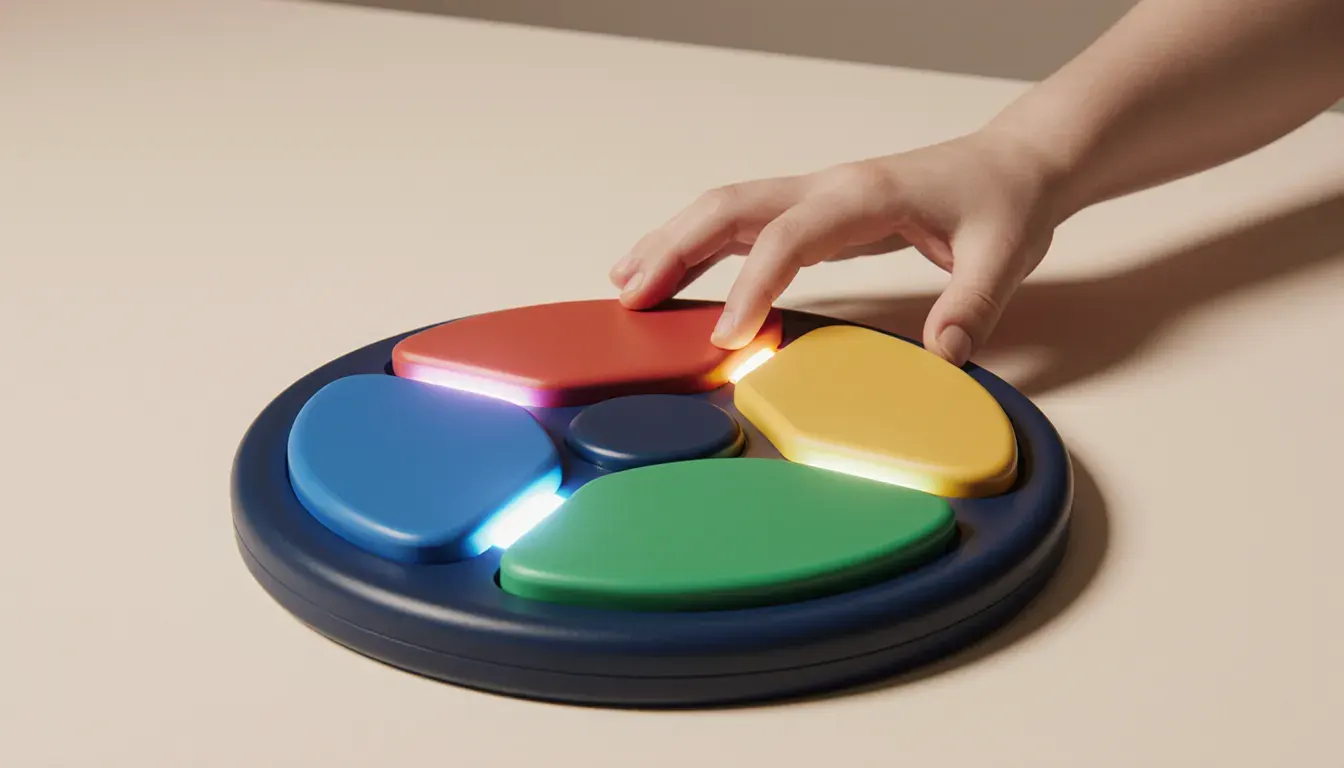
Every round starts from the beginning
How to play
- Simon lights one button and plays its tone. You press the same button.
- Simon plays the sequence again from the start, now with a new step at the end. You repeat all of it.
- And so on, one step longer each round.
- One wrong button ends the game. So does waiting too long between presses, because each press has a time limit.
The sequence is never reshuffled. Round six is round five plus one step, so everything you've already learned still counts. Your score is simply how far you got.
Where Simon came from
Ralph Baer and Howard Morrison invented Simon at the toy design firm Marvin Glass and Associates. Milton Bradley launched it in 1978 with a party at Studio 54 in New York, at $24.95. Milton Bradley is part of Hasbro today.
The idea came from Touch Me, an Atari arcade game from 1974. Baer liked how it played but not how it looked or sounded: the buttons were all black and the tones were harsh. So Simon got four bright colours, and tones from an A major chord (E, C♯, A and a lower E), chosen to sound good together in any order. The name comes from the children's game Simon Says.
Simon in numbers
Source: Simon (game) on Wikipedia, read on 5 November 2026.
How to remember a longer sequence
Holding a long string of flashing colours in your head is hard for everyone. A few habits make a real difference:
- Say the colours. Name each one under your breath as it lights up: “red, blue, blue, green”. Words stick better than flashes.
- Group them. Learn the sequence in threes. Nine colours in a row is a lot; three short groups is much easier.
- Listen to the tones as a tune. Some players hum the sequence instead of watching it.
- Notice the path the light takes around the board, as if someone were tracing it with a finger.
- Don't rush the start. You know the first steps best, so press them steadily and save your attention for the new step at the end.
Nine colours, or three groups of three
How far is good?
The original toy had four skill levels. To win, you had to repeat a sequence of 8, 14, 20 or 31 steps, depending on the level you picked. Getting all the way through 31 meant beating the toy.
If you're new to it, getting past 8 is a good first goal. After that it's you against your own best.
Playing Simon on an iPhone
You can still find Simon as a toy, and there are plenty of versions in the browser and the App Store.
I made Molly, my own take on the game for iPhone and iPad. Four colours, each with its own tone, and one more step every round. You choose the speed: Relaxed gives you 7 seconds for each press, Normal 5 and Fast 3. Shapes on the colours let you play without having to tell the colours apart, and Molly remembers your best streak.
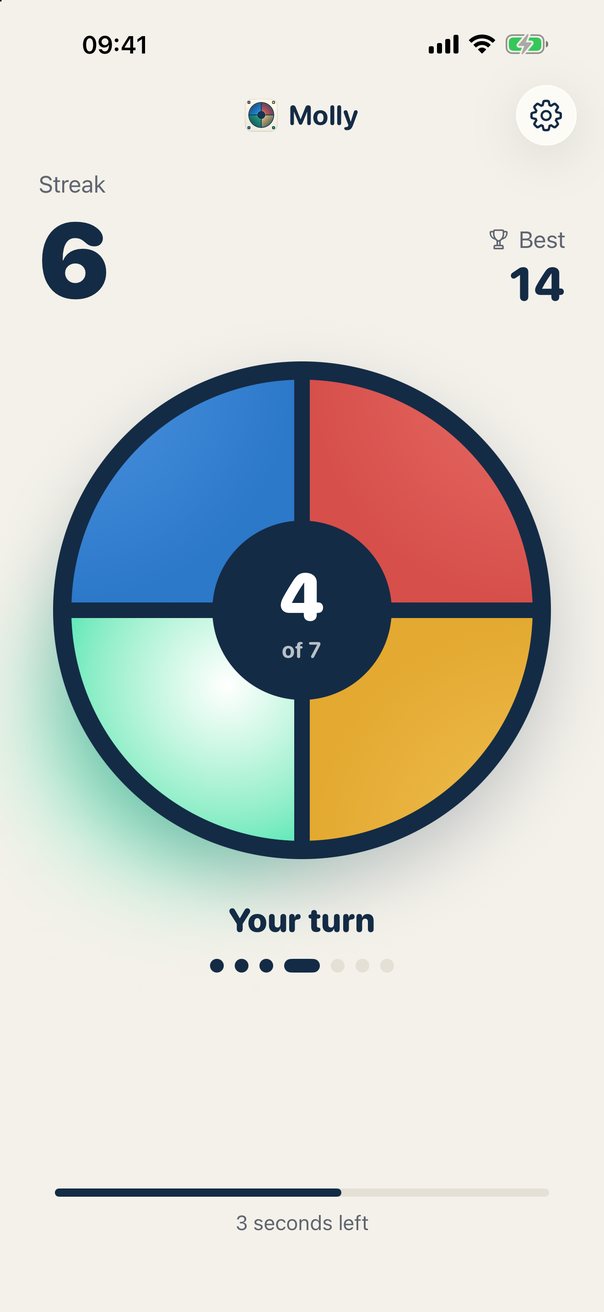 1Step 4 of 7 this round2Time left for this press
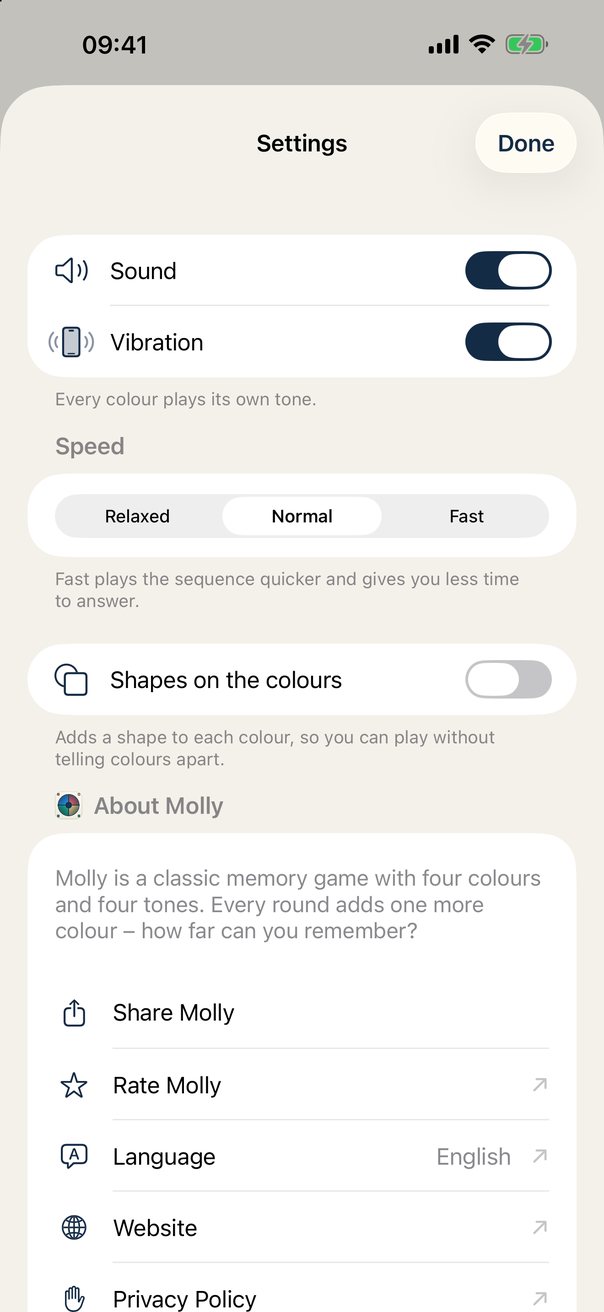 3Relaxed, Normal or Fast4Shapes on the colours
- Step 4 of 7 this round
- Time left for this press
- Relaxed, Normal or Fast
- Shapes on the colours
Molly costs $1.99, once. No ads, no account, and nothing leaves your phone.